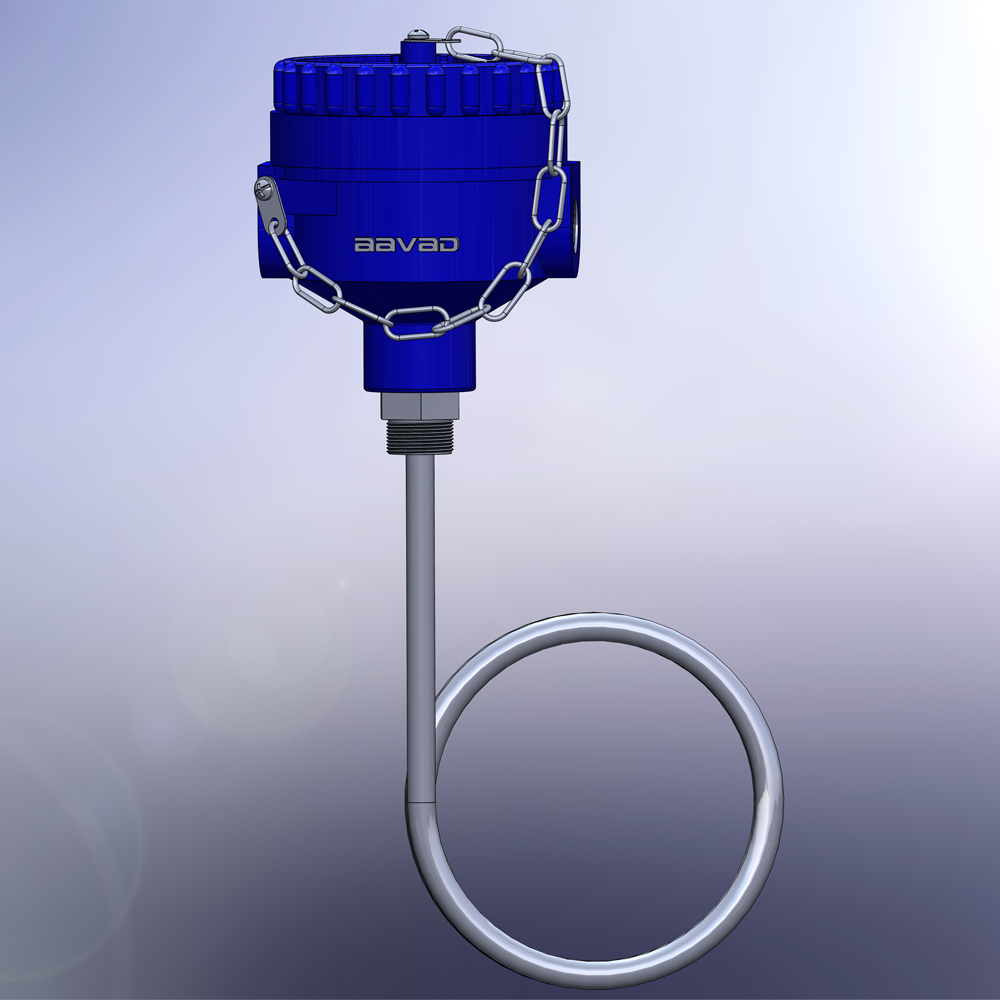
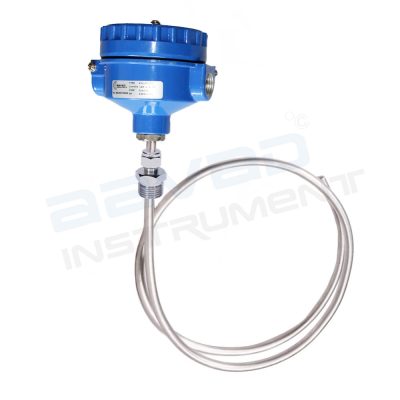
Duplex RTD Sensor 2400mm Price: the APFD-6×2400 is a duplex, 3+3-wire PT100 head-type RTD sensor (Class A (IEC 60751), -50 to 400 °C) with a 6 mm SS316 sheath and an IP67 die-cast aluminium head. It is listed at ₹1,690 with transparent factory pricing, so you can order directly without waiting for a quotation.
One failed element in a single-element loop means a shutdown or a manual override. The APFD-6×2400 carries two independent PT100 elements (3+3 wire) in one 6 mm sheath, so one element can feed control while the other drives a monitoring channel, recorder or standby input. At 2400 mm the probe reaches deep into tanks, ducts and long vessels where immersion depth is the usual cause of reading error; a sensor that is too short reads the wall or the stem instead of the medium.
Inside the sheath, compacted MgO insulation holds the platinum element and lead wires rigid, keeps moisture away from the sensing tip and limits drift from vibration and thermal cycling across the -50 to 400 °C range. Each of the two elements is wired 3-wire, so a transmitter or RTD card can cancel lead-wire resistance on either channel independently. A nickel-plated ceramic terminal block carries the connections at the head, and the 1/2″ NPT (F) cable entry (double) takes standard cable or gland fittings.
Specifications
| Type |
PT100 |
| Manufacturer |
Aavad Instrument Pvt. Ltd. |
| Model |
APFD-6×2400 |
| Configuration |
Duplex |
| No. of wire |
3+3 Wire |
| Accuracy |
Class A |
| Temperature range |
-50 To 400℃ |
| Material of construction |
SS316 |
| Insulation |
Compacted MgO insulation |
| Process connection |
1/2″ BSP (M) Fix fitting |
| Protection head |
Die-Cast aluminum head with threaded cap & chain |
| Head protection class |
IP67 |
| Head cable entry connection |
1/2″ NPT (F) |
| No. of cable entry |
Double |
| Terminal block |
Nickel-plated ceramic terminal block |
| Od |
6 mm |
| Length below head |
2400 mm |
Key Features
• Class A PT100 element: Platinum RTD with 100 Ω nominal resistance at 0 °C, Class A (IEC 60751) accuracy for stable and repeatable temperature readings from -50 to 400 °C.
• SS316 sheath, 6 mm OD: Corrosion-resistant stainless steel sheath with compacted MgO insulation and 2400 mm insertion length below the thread for efficient heat transfer to the sensing tip.
• Duplex configuration, 3+3 wire: Two independent PT100 elements in a single probe for control and monitoring or primary and standby operation without requiring a second process penetration.
• IP67 die-cast aluminium head: Threaded cap with retaining chain, nickel-plated ceramic terminal block, and 1/2″ NPT (F) cable entry.
• Process connection: 1/2″ BSP (M) fixed fitting for direct pipe and vessel mounting with a fixed immersion depth.
Applications
• Chemical Processing: Deep reactors and storage tanks where a long immersion length is required to reach mid-level liquid.
• Boiler Feedwater Lines: Feedwater, condensate, and hot-water headers with sheath temperatures up to 400 °C.
• HVAC Fluid Systems: Chilled-water, hot-water, and heat-recovery loops.
• Wastewater Treatment: Deep clarifiers, digesters, and sump tanks where a 2.4–3 m probe reaches representative liquid.
• Thermal Power Plants: Auxiliary steam, lube-oil, and cooling-water lines.
• Furnace & Process Heating Auxiliaries: Control plus independent monitoring or standby measurement at the same measurement point.
FAQs
1. Can the Duplex RTD Sensor 2400mm be made in a custom sheath length or process connection?Yes. The standard configuration is 6 × 2400mm with a 1/2″ BSP (M) fixed fitting. Custom configurations may be available with different sheath lengths, process connections, thread sizes, and cable entries. For bulk or project requirements, submit an RFQ (Request for Quotation) with your required specifications to confirm feasibility, configuration, and direct factory pricing.2. What does 3+3 wire duplex mean on this PT100 sensor?3+3 wire duplex means the probe contains two independent PT100 sensing elements, with each element having its own 3-wire connection. One circuit can be used for process control, while the second can be connected for temperature monitoring, recording, standby measurement, or a separate control system. Compatible transmitters or RTD input cards can compensate for lead-wire resistance on each individual 3-wire circuit.